New journal article: Ab-initio heat transport in defect-laden quasi-1D systems from a symmetry-adapted perspective
We have published a new study presenting a symmetry-resolved framework to understand heat transport in defect-laden quasi-one-dimensional materials, with a focus on dichalcogenide nanotubes. By combining representation theory with a mode-resolved atomistic Green’s function approach, our work enables phonon transport in quasi-1D systems to be analyzed from a symmetry-based perspective.
Using line-group symmetries and symmetry-adapted phonon modes, we systematically investigate heat transport across pristine and defect-containing MoS2–WS2 MoS2–WS2 nanotube heterostructures. To achieve near ab-initio accuracy at tractable computational cost, we employ a machine-learning interatomic potential (Allegro) trained on first-principles data, which significantly reduces the computational cost on interatomic force constants.
This figure illustrates how structural symmetry controls phonon heat transport through the defect-laden interface. By visualizing mode-to-mode phonon transmission in nanotubes and classifying those modes according to the irreps of the line group, the figure reveals a striking contrast between ordered and symmetry-broken interfaces. When the defect preserves the high symmetry (a), phonons are confined to transmit only within symmetry-allowed channels (diagonal blocks). In contrast, strong symmetry breaking (b) activates additional transmission pathways between different phonon modes, allowing heat to flow through channels that are otherwise forbidden. This mode-resolved view provides clear evidence that lowering symmetry can unexpectedly enhance thermal transport by opening more transmission channels.
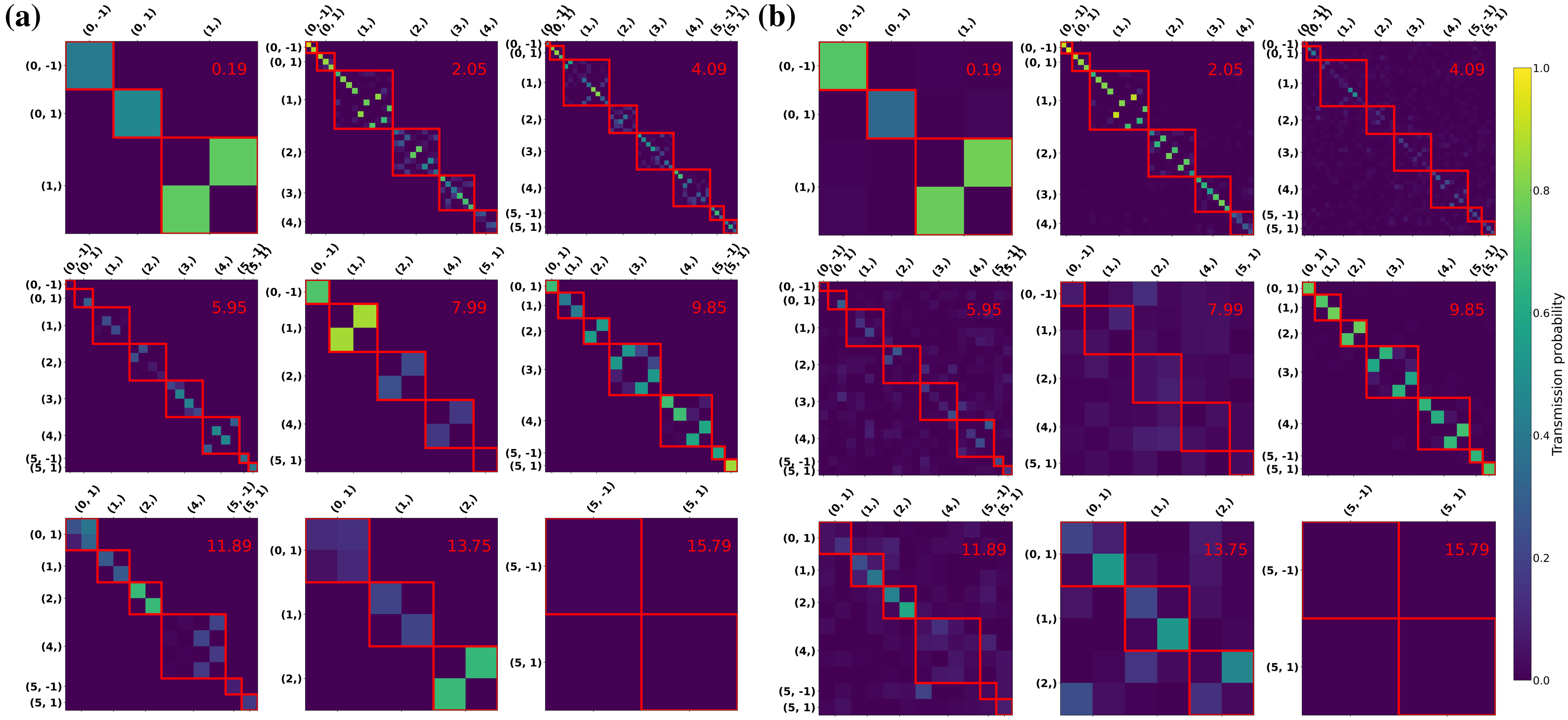
Our results reveal a counterintuitive effect: strong symmetry breaking introduced by certain defects can enhance thermal transport rather than suppress it. By relaxing symmetry-imposed selection rules, low-symmetry defects open additional phonon transmission channels between different irreps, demonstrates the critical role of symmetry in deciphering the nuances of nanoscale thermal transport.