New journal article: Accelerating first-principles molecular-dynamics thermal conductivity calculations for complex systems
The PULGON team has recently published a new research paper entitled “Accelerating First-Principles Molecular-Dynamics Thermal Conductivity Calculations for Complex Systems” in the Journal of Chemical Theory and Computation. In this article, we analyze different methods to obtain the thermal conductivity from Green-Kubo simulations to address one of the key issues of this method: its slow convergence due to noisy correlation functions.
The article covers the differences discovered for two quasi-one-dimensional example systems, an InAs nanowire in zincblende and wurtzite phase. For the former, cepstral analysis, a technique to denoise the power spectrum of the heat flux leads to consistent and well converged results for low simulation times. However, for the wurtzite nanowire, which features a much higher thermal conductivity, we show that this approach fails due to sharp peaks in the low frequency region of the power spectrum. In such a case, a more traditional analysis technique is necessary. We apply several different analysis strategies, such as the recently proposed KUTE approach to mitigate the effect of arbitrary choices in the evaluation of the integral. Here, we propose an extension utilizing uncertainties, in whose propagation covariance contributions cannot be neglected, to estimate the error of the thermal conductivity mitigating the effect of arbitrary choices.
The key issue with Green-Kubo simulations is shown by the large spread of the resulting thermal conductivities from independent simulation in the left panels of the figure below. Despite the similarities of the base structure, both the zincblende and wurtzite InAs nanowires feature very different thermal conductivity values leading to differing effectiveness of analysis methods. For the low conductivity nanowires, cepstral analysis (top right) leads to fast convergence with small errors, while for high conductivity methods long simulations are still required, where an uncertainty based analysis is highly beneficial for the analysis (bottom right).
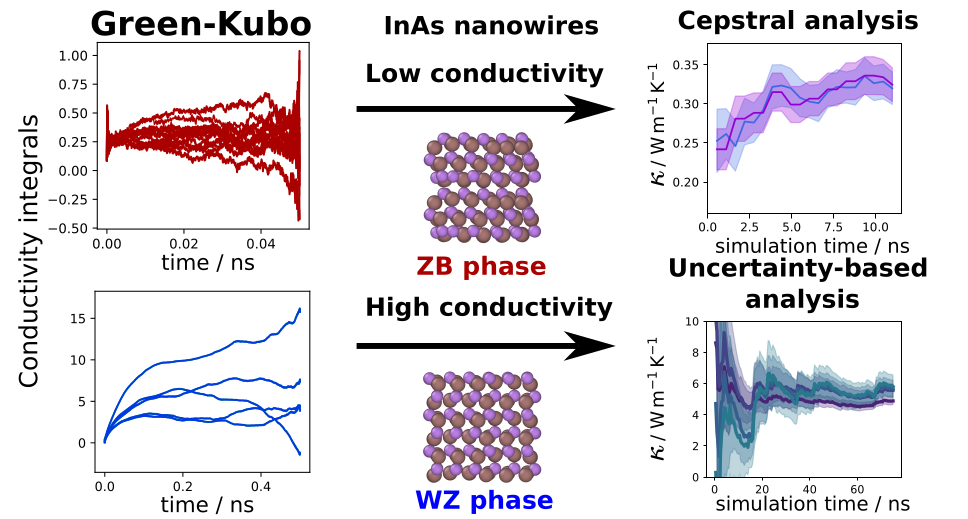
Our analysis reveals that for high conductivity materials, very long simulations are difficult to avoid and that the statistical error range is large. However, for low conductivity systems cepstral analysis can be an excellent tool to curb the simulation time required allowing efficient high-throughput studies. Overall, our findings highlight that while cepstral analysis can be highly effective, its applicability is system-dependent and must be carefully assessed for each target material.